Direct Drive Wheel Modules for Industrial and Commercial Robots
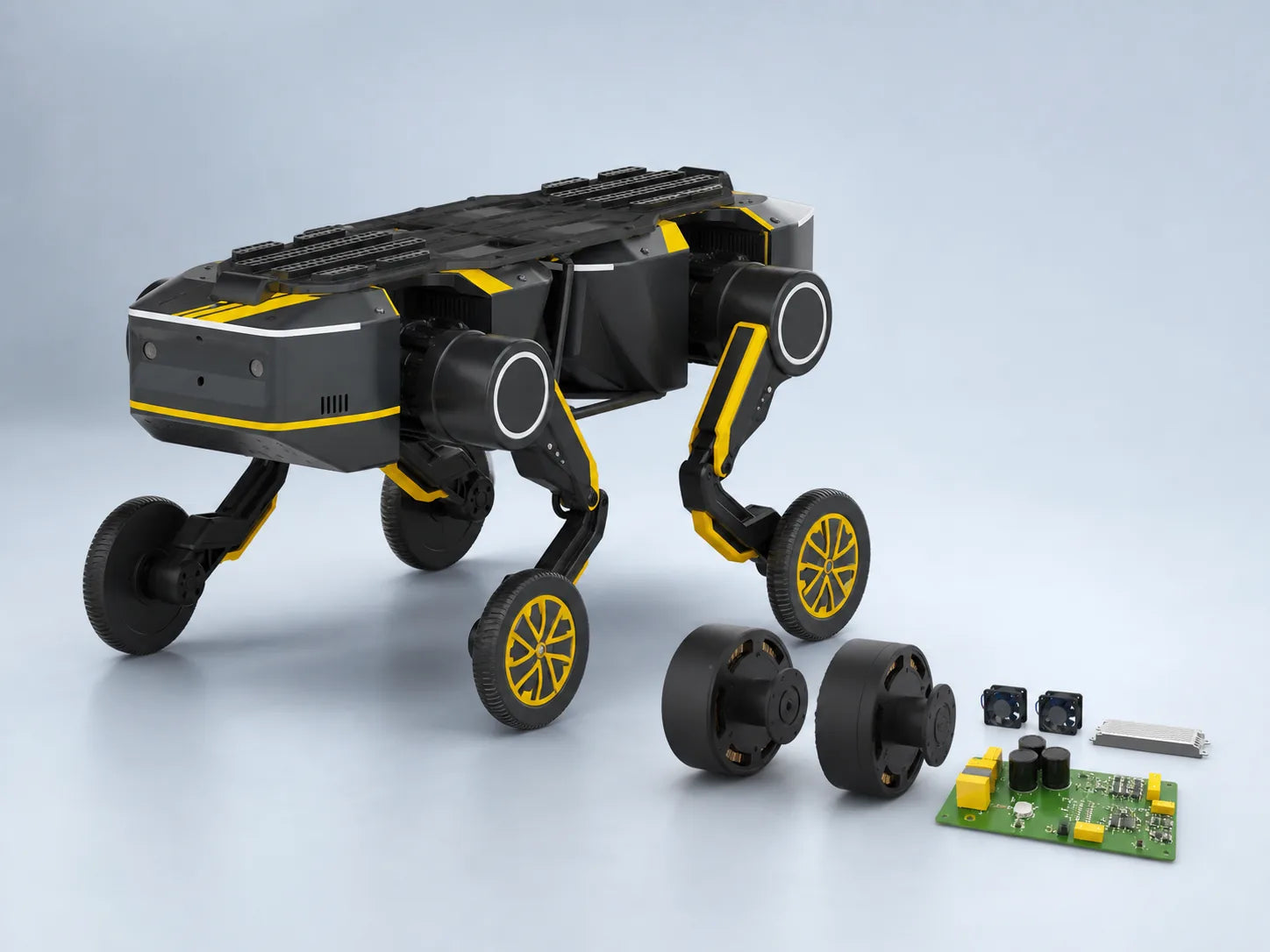
Direct drive wheel modules combine the motor, encoder, bearings, and wheel into one assembly, removing gearboxes and other mechanical transmission parts. This design can improve mechanical efficiency to more than 90%, reduce maintenance intervals by eliminating gearbox servicing, and provide repeatable positioning accuracy measured in millimeters. Many industrial mobile robots now operate more than 20 hours per day, making lower energy use and fewer wear parts increasingly important. Modern systems also support EtherCAT, CANopen, and other industrial communication protocols, allowing faster integration into autonomous mobile robots used in manufacturing, warehousing, healthcare, airports, and commercial buildings.
Industrial and commercial robots are expected to continue expanding across manufacturing, logistics, healthcare, and retail during the second half of this decade. Market studies published between 2023 and 2025 estimate annual growth rates above 15% for autonomous mobile robots in several regions. As robot fleets grow from dozens to hundreds of vehicles inside one facility, wheel performance becomes just as important as navigation software because every meter traveled depends on stable motion and consistent torque output.
Conventional drive systems normally include a motor, gearbox, coupling, and additional transmission parts. Each mechanical interface introduces friction, wear, and efficiency losses over time. Direct drive technology removes several of these components by connecting the motor directly to the wheel hub. Fewer moving parts reduce mechanical contact, allowing smoother acceleration and more repeatable movement after thousands of operating hours.
Many warehouse robots travel between 15 and 35 kilometers every day. Over one year, that can exceed 8,000 kilometers for a single vehicle, making drivetrain reliability more important than occasional peak speed.
Position accuracy also improves because there is no gearbox backlash. High-resolution encoders with resolutions reaching millions of counts per revolution allow servo controllers to detect even very small position changes. In pallet transport, semiconductor production, pharmaceutical handling, and electronics assembly, positioning errors below 2 mm can reduce alignment corrections and shorten cycle times. Better motion control also produces smoother turning, which helps protect transported goods from vibration.
The same mechanical design also affects energy consumption. Gear reduction systems typically lose part of the motor output through friction and lubrication resistance. Direct drive systems send torque directly to the wheel, allowing more electrical energy to become useful mechanical motion. Battery-powered robots operating 16 to 24 hours per day may complete additional working cycles before charging, depending on payload, floor conditions, travel speed, and route planning.
| Comparison | Traditional Geared Drive | Direct Drive Wheel Module |
|---|---|---|
| Mechanical Parts | Higher | Lower |
| Gearbox Maintenance | Required | Not Required |
| Backlash | Present | Minimal |
| Noise Level | Higher | Lower |
| Motion Response | Slower | Faster |
| Energy Transfer | Lower | Higher |
As battery technology improves, motor design continues to advance as well. Permanent magnet synchronous motors now deliver higher torque density than many earlier industrial motors while maintaining compact dimensions. Better cooling channels, improved winding materials, and optimized electromagnetic designs allow continuous operation even under heavy payloads exceeding several hundred kilograms on larger autonomous vehicles. These improvements also benefit AMR wheel module motors, which are increasingly selected for logistics platforms requiring continuous daily operation.
Integration has also become much simpler. Many manufacturers now supply complete wheel modules that include the motor, encoder, brake, steering actuator, bearings, and drive electronics inside one housing. Engineers spend less time designing separate mounting systems, wiring harnesses, and protective enclosures. Standard communication protocols including EtherCAT, PROFINET, EtherNet/IP, CANopen, and Modbus make software integration easier across different automation platforms.
For buyers comparing available products, specifications usually include continuous torque, peak torque, wheel diameter, steering angle, encoder resolution, ingress protection rating, maximum vehicle weight, operating temperature, communication interface, and braking options. Selecting the correct wheel module depends on floor material, expected duty cycle, payload distribution, acceleration requirements, and available battery capacity rather than motor power alone. More product specifications can be found for the AMR wheel module motors used in industrial mobile robot applications.
Robots operating inside hospitals, airports, and commercial buildings often place greater importance on quiet operation than maximum speed. Direct drive systems reduce mechanical noise because there are fewer contacting transmission components.
Maintenance planning also changes after removing the gearbox. Traditional systems often require lubrication, gear inspection, seal replacement, and periodic backlash adjustment. Direct drive modules reduce scheduled maintenance because bearings become the primary mechanical wear component. Combined with built-in temperature sensors, encoder diagnostics, and motor current monitoring, maintenance teams can monitor operating conditions continuously instead of relying only on fixed inspection intervals. Many industrial facilities now connect these operating data to cloud-based maintenance software for long-term equipment monitoring.
Software improvements continue to increase the capabilities of direct drive mobility systems. Modern field-oriented control algorithms calculate motor current thousands of times every second, producing smoother acceleration and stable low-speed movement. Combined with LiDAR, cameras, inertial sensors, and simultaneous localization and mapping (SLAM), mobile robots can navigate narrow warehouse aisles, avoid moving workers, and stop within short distances while maintaining stable wheel control.
Industries using direct drive wheel modules continue to expand beyond manufacturing. Distribution centers use autonomous vehicles for pallet movement, hospitals transport medicine and laboratory samples, airports move baggage carts and cleaning equipment, while commercial buildings deploy delivery and service robots. As facilities operate longer hours and automation rates continue increasing beyond 2025, demand for reliable, compact, and efficient wheel modules is expected to grow across industrial and commercial robotics.